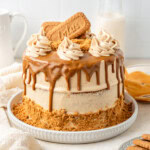
Vegan Biscoff Cake
This vegan biscoff cake has a rich brown sugar and cinnamon spiced flavour thanks to the addition of Lotus biscoff spread. It’s filled and topped with a vegan biscoff buttercream and topped with a drizzle of more biscoff spread. Cookie butter lovers won't be able to get enough of this vegan and dairy free layer cake!
Servings 16 servings
Calories 419kcal
Equipment
Ingredients
For the vegan biscoff cake:
- 1 cup dairy free milk
- 1 ½ tablespoons white vinegar
- 2 cups plain flour/all purpose flour
- 1 teaspoon baking powder
- ½ teaspoon bicarbonate of soda/baking soda
- ½ teaspoon salt
- ½ cup canola oil
- ¾ cup brown sugar
- 1 tablespoon vanilla extract
- 150 grams biscoff spread smooth
For the vegan biscoff buttercream:
- 125 grams vegan butter
- 100 grams biscoff spread smooth
- 2 teaspoons vanilla extract
- 3-4 cups icing sugar
- 3-4 tablespoons dairy free milk
- ¼ teaspoon salt
To decorate:
- Lotus biscoff biscuits
- ¼ cup biscoff spread smooth
Instructions
- Preheat the oven to 180°C (350°F) and line the base of 3 x 6 inch (15.2 cm) cake pans with baking paper and a light spray of cooking oil on the bottom and sides of the pans.
- In a small bowl combine white vinegar and dairy-free milk. Set aside.
- In a large bowl, whisk together the plain flour, baking powder, bicarbonate of soda and salt to combine.
- In a separate bowl, beat together the canola oil, brown sugar, vanilla extract and biscoff spread until well combined using a handheld eclectic mixer.
- Add half of the dry ingredients into the wet and half of the milk mixture and mix until combined. Add in the remainder of the dry ingredients along with the milk and again beat until the cake batter just comes together being careful not to overmix.
- Divide the batter evenly between the 3 pans and place in a preheated oven to bake for 30 minutes, or until the cake just springs back when lightly pressed. Take the cakes out of the oven and let cool in the pan for 10 minutes before turning out onto a wire rack to cool completely.
- Make the buttercream. Using a hand mixer or a stand mixer with the whisk attachment fitted, beat the vegan butter, biscoff spread, and vanilla for 1-2 minutes until creamy and combined.
- Add in 2 cups of icing sugar and beat on medium until combined. Add in an additional cup of icing sugar and continue to mix. As mixture thickens, add in the dairy free milk a little at a time until you reach a thick, creamy consistency. If the frosting is too thin or tastes too ‘buttery’, add in an extra ½-1 cup of icing sugar, and if it’s too thick, add a little bit more dairy free milk. Finally add salt to taste and continue to mix until super creamy.
- Assemble the cake. Place a small amount of the buttercream on a cake stand or plate and place the first cake layer down. If your cake layers have domed, make sure to level them first with a serrated knife.
- Add enough frosting to thickly cover the layer and then add the second cake layer on top. Add more frosting, then the final cake layer upside down so the top of the cake is flat. Add more frosting to the top and side of the cake using your offset spatula and use a cake scraper or knife to smooth out the edges and remove any excess frosting. Place the cake in the fridge or freezer to chill for at least 30 minutes.
- Once the cake is cold, add another layer of buttercream to the tops and sides and use a cake scraper or knife to smooth out the edges.
- Decorate the cake. Crush up some biscoff biscuits using a mortar and pestle or a zip lock bag and a rolling pin and then use your hands to gently press the cookie crumbs around the base of the cake.
- Melt extra biscoff spread in a small bowl in the microwave for 30 seconds until it’s a thin consistency. Use a teaspoon to gently spoon the biscoff onto the top edge of the cake so it flows over the edge and drips down. Once you’ve worked your way around the cake, spread any leftover biscoff over the top and then finish with some buttercream swirls and extra cookie crumbs in the centre.
- Chill the cake to allow it to set before slicing and serving.
Nutrition
Serving: 1slice | Calories: 419kcal | Carbohydrates: 56g | Protein: 3g | Fat: 20g | Saturated Fat: 4g | Polyunsaturated Fat: 4g | Monounsaturated Fat: 7g | Trans Fat: 0.1g | Sodium: 233mg | Potassium: 60mg | Fiber: 0.5g | Sugar: 39g | Vitamin A: 367IU | Vitamin C: 1mg | Calcium: 51mg | Iron: 1mg
